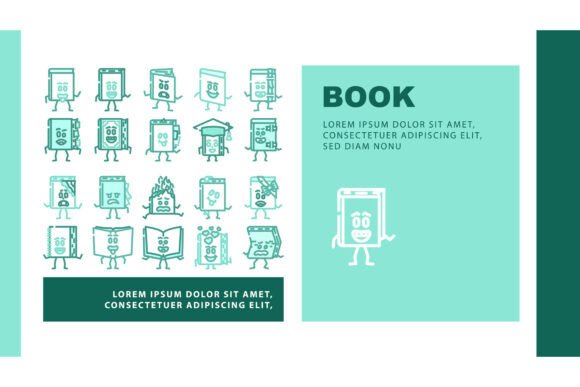
Bringing Stories to Life: The Power of Book Character School Landing Header Vec
In the digital landscape where attention spans are fleeting and visual engagement is paramount, the intersection of education, literature, and graphic design has never been more critical. At the heart of this convergence lies a specific aesthetic and functional tool known as the Book Character School Landing Header Vec. This vector-based illustration style is not merely a decorative element; it serves as a foundational component for educators, authors, publishers, and web designers aiming to create immersive learning environments. By combining the whimsical charm of a girl with a notebook, the structured atmosphere of a library, and the dynamic energy of student book characters, these visuals establish an immediate emotional connection with the audience.
The utility of such imagery extends far beyond simple decoration. When implemented correctly in a book character school landing web page vector format, these graphics act as navigational signposts, guiding users through complex educational content while maintaining a sense of wonder. Whether you are a professional designer crafting a curriculum platform or a hobbyist creating a children's story website, understanding the nuances of this visual language is essential for effective communication.
The Anatomy of Educational Visual Storytelling
To truly appreciate the impact of the Book Character School Landing Header Vec, one must first deconstruct its constituent elements. These illustrations are rarely random; they are carefully curated compositions designed to evoke specific psychological responses related to study, education, and literature. A typical composition might feature a young girl holding a notebook, surrounded by floating books, open encyclopedias, and perhaps a friendly mascot representing a student book character.
The choice of a girl notebook motif is particularly significant. It represents the active participant in the learning process—the student who is ready to write, learn, and discover. In contrast, the background elements, often resembling a cozy library or a bustling classroom, provide context. They signal safety, knowledge, and community. When these elements are rendered as a high-quality vector, they offer scalability without loss of resolution, making them ideal for everything from mobile app icons to massive billboard-sized posters.
This specific style of illustration bridges the gap between traditional poster literature and modern digital interfaces. Unlike static photographs that can feel stiff or overly formal, the illustrative nature of the study education theme allows for a level of abstraction that appeals to both children and adults. It simplifies complex concepts into relatable symbols, making the prospect of learning feel less like a chore and more like an adventure.
Scalability and Technical Precision in Vector Art
From a technical standpoint, the decision to use vector formats for these school-themed headers is driven by necessity. Web pages today are viewed on a myriad of devices, ranging from small smartphones to large desktop monitors. Raster images, which rely on pixels, often suffer from blurriness when scaled up. Vectors, however, are mathematically defined shapes and lines. This means a book character school landing header vec file can be resized infinitely without any degradation in quality.
For developers and designers, this flexibility is invaluable. It ensures that the library shelves in the background remain crisp on a retina display, just as the student book character remains sharp on a low-resolution tablet. Furthermore, vector files are generally smaller in file size compared to high-resolution raster images, leading to faster load times—a crucial factor for search engine optimization (SEO) and user experience (UX). In an era where every millisecond counts, the efficiency of vector art cannot be overstated.
Strategic Applications Across Diverse Sectors
The versatility of the Book Character School Landing Header Vec allows it to serve a broad audience, including professionals, consumers, creators, and business owners. Its applications are as varied as the industries that utilize it, proving that the love for stories and learning transcends age and profession.
Empowering Educators and Schools
For educators, these visuals are powerful tools for engagement. A school website featuring a vibrant header with a children poster literature style can instantly set a welcoming tone for parents and students alike. It communicates that the institution values creativity and imagination alongside academic rigor. Teachers can also use these vectors in lesson plans, worksheets, and digital presentations to break up text-heavy content and maintain student interest. The familiar imagery of a girl notebook or a student book character helps ground abstract concepts in a tangible, friendly reality.
Enhancing Digital Publishing and Author Platforms
Authors and publishers are increasingly turning to these illustrations to market their work. A landing page for a new children's book series benefits immensely from a header that visually encapsulates the story's themes. If the book is about a magical library, a vector illustration depicting a library setting with animated characters can draw readers in immediately. This approach aligns with the principles of visual storytelling, ensuring that the marketing material reflects the narrative voice of the book itself. It creates a cohesive brand identity that resonates with young readers and their guardians.
Designing for EdTech Startups and Apps
In the competitive world of educational technology, first impressions are made within seconds. An EdTech startup launching a new learning app needs a landing page that clearly communicates its value proposition. Using a book character school landing web page vector as the central hero image can achieve this effectively. It signals that the product is child-friendly, safe, and focused on literacy and education. The clean lines and bright colors typical of these illustrations suggest a modern, user-friendly interface, encouraging users to download or sign up.
The Psychology Behind the Illustration Style
Why do these specific images resonate so deeply? The answer lies in the psychology of color, form, and association. The poster literature style often employs bold, saturated colors that stimulate excitement and curiosity. The rounded shapes found in many student book character designs convey softness and approachability, reducing anxiety associated with learning difficulties.
Furthermore, the inclusion of objects like notebooks and books triggers a cognitive association with achievement and growth. When a viewer sees a girl notebook illustration, they subconsciously recall their own experiences of writing, reading, and discovering new things. This nostalgia, combined with the forward-looking nature of a school setting, creates a positive feedback loop. It encourages the viewer to re-engage with the learning process, whether they are a child starting school or an adult returning to education.
The dynamic arrangement of these elements in a Book Character School Landing Header Vec also plays a role. Unlike static, symmetrical compositions, these vectors often feature asymmetry and movement. Books might appear to be flying off shelves, or characters might be mid-action. This kinetic energy suggests that learning is an active, ongoing journey rather than a passive state. It invites the viewer to step into the scene and become part of the story.
Accessibility and Inclusivity in Design
A critical consideration in modern design is inclusivity. High-quality vector illustrations allow for greater customization regarding representation. Designers can easily adjust the features of the children characters to reflect a diverse range of ethnicities, abilities, and backgrounds. This is particularly important for educational materials, where seeing oneself represented can significantly boost confidence and engagement. The flexibility of the vector format ensures that these adjustments can be made without compromising the overall aesthetic or requiring a complete redesign.
Optimizing for Search and User Engagement
From an SEO perspective, the strategic use of these visuals contributes to a site's overall performance. While search engines cannot "see" images in the same way humans do, they rely on alt text, file names, and surrounding content to understand the context. Describing an image as a book character school landing header vec with relevant keywords like study education, library, and student book character helps search engines index the page correctly.
Moreover, engaging visuals reduce bounce rates. When users land on a page and see a compelling, high-quality illustration that matches their search intent, they are more likely to stay and explore. This increased dwell time is a positive signal to search algorithms, potentially improving the site's ranking. For business owners and marketers, this means that investing in professional vector art is not just an aesthetic choice but a strategic one that drives traffic and conversions.
Integrating with Content Strategy
To maximize the impact of these headers, they should be integrated seamlessly with the written content. The illustration should complement the headline and the body text, reinforcing the message rather than distracting from it. For example, if the article discusses the importance of early literacy, the header could feature a girl notebook with words floating around her, visually representing the concept of writing and expression. This synergy between text and image creates a holistic user experience that is both informative and enjoyable.
Future Trends in Educational Graphics
As technology evolves, so too does the style of educational illustrations. We are seeing a shift towards more interactive and animated vector graphics. Imagine a book character school landing web page vector where the student book character waves at the user upon loading the page, or where the library books open when hovered over. These micro-interactions add a layer of delight and functionality that static images cannot provide.
Additionally, there is a growing trend towards sustainability and eco-conscious design. Many creators are opting for palettes inspired by nature, using earthy tones alongside the traditional bright colors. This reflects a broader societal shift towards environmental awareness, even in the realm of children's education. The poster literature style is adapting to include these themes, ensuring that the next generation of learners is exposed to messages of stewardship and care for the planet.
Ultimately, the Book Character School Landing Header Vec represents more than just a graphic asset. It is a testament to the enduring power of storytelling and the vital role of education in our lives. By leveraging the strengths of vector art, designers and educators can create spaces that inspire, inform, and engage audiences across the globe. Whether used in a school, a publishing house, or a tech startup, these illustrations continue to shape the way we perceive and interact with the world of learning.