School Rules Vocabulary Word Search Puzzles: An Interactive Guide to Learning
In the dynamic landscape of modern education, finding effective ways to reinforce essential concepts without resorting to rote memorization is a priority for both educators and parents. One of the most engaging methods to achieve this is through School Rules Vocabulary Word Search Puzzles. These activities are far more than simple pastimes; they represent a multifaceted approach to learning that blends education with excitement. By integrating vibrant word searches, dynamic scrambles, and thought-provoking crossword puzzles, these resources cater to a variety of age groups while seamlessly introducing or reinforcing school rule concepts.
This article explores the significance of these interactive tools, how they enhance cognitive skills, and why they are becoming an indispensable part of parent and teacher resources. Whether you are looking to support your child's visual recognition skills or seeking an immersive way to discuss classroom expectations, understanding the value of these puzzles is the first step toward a more engaging academic adventure.
The Evolution of Educational Games in the Classroom
Traditionally, teaching school rules involved lectures, posters on the wall, and repetitive drills. While necessary, these methods often lacked the element of fun that captures a young mind. The shift towards gamified learning has transformed how children absorb information. A School Rules Vocabulary challenge is not just a worksheet; it is an adventure in academia that leverages the brain's natural affinity for pattern recognition and problem-solving.
Modern educational theory suggests that when students are actively engaged in decoding words and solving puzzles, their retention rates increase significantly. This is because the activity requires active participation rather than passive listening. By embedding vocabulary related to conduct, respect, and safety into a game format, we create a positive association with the rules themselves. Instead of viewing rules as restrictive, students begin to see them as part of a shared language that keeps the learning environment safe and productive.
Why School Rules Vocabulary Matters
Before diving into the mechanics of the puzzles, it is crucial to understand why mastering school rules vocabulary is fundamental. Terms such as respect, integrity, punctuality, collaboration, and responsibility form the backbone of a functional educational community. When children can identify and define these terms, they are better equipped to navigate social interactions and understand behavioral expectations.
Furthermore, these words often carry nuanced meanings that go beyond simple definitions. For example, "respect" in a school context involves listening to others, valuing diverse opinions, and maintaining a clean environment. Through targeted vocabulary exercises, students can explore these nuances in a low-stakes environment, preparing them for real-world application.
A Multifaceted Approach to Engagement
The true power of our School Rules Vocabulary challenge lies in its diversity. It is not limited to a single type of puzzle but offers a comprehensive suite of activities designed to stimulate different cognitive pathways. This variety ensures that learners with different strengths—whether visual, logical, or linguistic—can find success and enjoyment.
1. The Vibrant Word Search
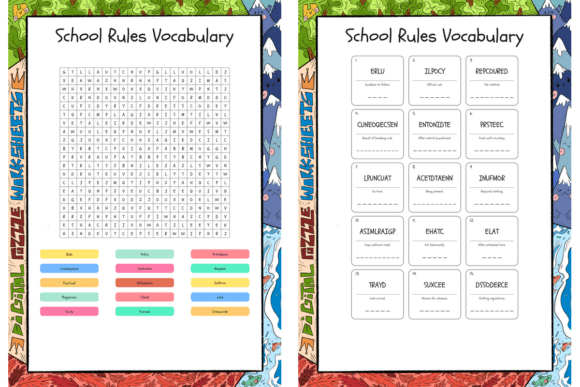
The cornerstone of this activity is the vibrant word search. This classic puzzle format is excellent for developing visual scanning skills and pattern recognition. In a school rules context, the grid is filled with key terms related to student conduct. As students hunt for words like "listen," "share," or "clean up," they are subconsciously reinforcing the spelling and meaning of these concepts.
- Visual Recognition: Students learn to spot specific letter combinations quickly, aiding in reading fluency.
- Focus and Concentration: Locating hidden words requires sustained attention, a skill transferable to other academic tasks.
- Vocabulary Retention: Repeated exposure to the target words within the grid helps cement them in long-term memory.
2. Dynamic Scramble Challenges
Once students have identified the words, the next level of engagement comes from the dynamic scramble. Here, the letters of a school rule term are jumbled, and the learner must rearrange them to form the correct word. This adds a layer of difficulty that challenges working memory and spelling accuracy.
For instance, a scrambled version of "HONESTY" might appear as "T-S-E-N-O-H." Solving this requires the student to recall the correct structure of the word, promoting deeper processing than simply finding it in a grid. This activity is particularly useful for older children who need to refine their orthographic knowledge.
3. Thought-Provoking Crossword Puzzles
The final component of this trifecta is the crossword puzzle. Unlike word searches, crosswords require a strong understanding of definitions and context. Clues might read, "Treating others with kindness and fairness (7 letters)," leading the student to write "RESPECT."
This format bridges the gap between vocabulary and comprehension. It forces students to think critically about what the rules mean, not just how they are spelled. It is an excellent tool for assessing whether a student truly understands the concept behind the word.
Practical Applications for Parents and Teachers
The versatility of these puzzles makes them ideal for various settings, from the home to the classroom. They serve as flexible resources that can be adapted to fit different schedules and learning goals.
Integrating into Daily Routines
For parents, these activities offer a screen-free alternative that supports homework time or weekend learning. They can be used as a warm-up exercise before discussing family rules, drawing parallels between home expectations and school expectations. For example, after completing a puzzle about "listening," a parent can ask their child to share a time when listening helped solve a problem at home.
Teachers can utilize these puzzles during morning meetings, transition times, or as part of a character education curriculum. Because the activities are self-contained and engaging, they minimize disruption while maximizing educational value. They are also perfect for early finishers, ensuring that all students remain productively engaged.
Supporting Diverse Learning Needs
One of the greatest advantages of this multifaceted approach is its inclusivity. Children with different learning styles benefit from the combination of visual (word search), kinesthetic (writing out answers), and logical (crossword clues) elements. Additionally, for English Language Learners (ELLs), these puzzles provide a structured way to acquire new vocabulary in a meaningful context.
By focusing on high-frequency words related to school life, ELL students can build a foundational lexicon that helps them navigate the social and academic demands of the classroom. The repetitive nature of the games allows for practice without the pressure of formal testing.
Common Misunderstandings About Educational Puzzles
Despite their benefits, there are some misconceptions surrounding the use of puzzles in education. A common assumption is that word searches and crosswords are merely "busy work" with little educational merit. However, research in cognitive psychology suggests otherwise.
When designed with specific learning objectives in mind—such as reinforcing school rules vocabulary—these puzzles become powerful pedagogical tools. They are not just about filling space; they are about building neural connections. Another misunderstanding is that these activities are only suitable for younger children. In reality, the complexity of the puzzles can be scaled to challenge middle and high school students, making them relevant across a wide age range.
Furthermore, some believe that digital apps have replaced the need for printable puzzles. While technology has its place, physical interaction with paper-based puzzles offers unique benefits, such as improved fine motor skills and reduced screen time. The tactile experience of circling words or writing in grids engages the brain differently than clicking a mouse or tapping a screen.
Fostering a Love of Learning
Ultimately, the goal of the School Rules Vocabulary challenge is to stimulate a love of learning. By presenting educational content in an exciting, game-like format, we remove the anxiety often associated with rules and regulations. Students begin to view the acquisition of knowledge as an enjoyable journey rather than a chore.
These activities support visual recognition skills, enhance vocabulary, and boost cognitive abilities, all while fostering a positive attitude toward school culture. They remind us that education should be an adventure, where every puzzle solved is a step toward becoming a more responsible, respectful, and capable individual.
Whether you are a teacher looking for fresh resources or a parent seeking to support your child's development, incorporating these interactive puzzles into your routine is a strategic move. It is an investment in a learning environment where fun and function coexist, paving the way for academic success and personal growth. Embrace the adventure in academia today and watch as your students discover the joy of mastering the language of school rules.