Evaluation of Education Kid Girl Practicing Handwriting Resources
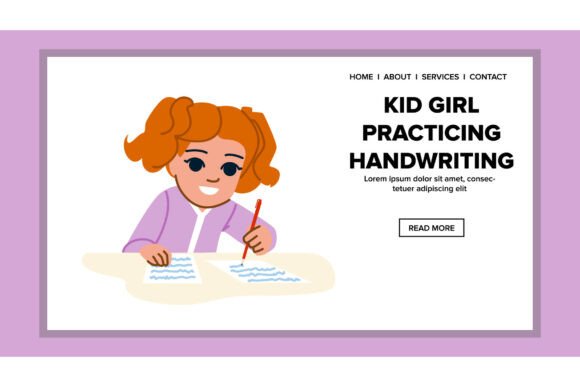
The concept of Education Kid Girl Practicing Handwritin refers to a specific category of educational materials and visual assets designed to depict young female students engaged in the act of writing. These resources typically manifest as vector illustrations, web graphics, or flat cartoon depictions used within digital and print media for early childhood development. When educators, parents, or content creators search for terms like "education kid girl practicing handwriting vector," they are often looking for more than just an image; they are seeking a representation of the foundational learning process that aligns with kindergarten English curricula and art book standards. Understanding the utility, aesthetic value, and practical application of these resources is essential for anyone involved in creating or selecting educational content.
Defining the Scope and Purpose
At its core, Education Kid Girl Practicing Handwritin serves as a visual shorthand for literacy development. In the context of school writing and kindergarten education, these images are not merely decorative. They function as instructional aids, motivational tools, and branding elements for educational platforms. A typical illustration features a young girl seated at a desk, holding a pencil, and focusing on paper, often surrounded by elements like books, letters, or colorful stationery. The "web flat cartoon illustration" style is particularly prevalent because it offers clarity, scalability, and a modern aesthetic that appeals to both children and adults navigating digital learning environments.
These visuals are frequently integrated into lesson plans, worksheets, website headers, and interactive applications. The primary goal is to create a relatable scenario for the target audience—children in their formative years. By seeing a peer figure engaged in the task, learners may feel a sense of familiarity and encouragement. Furthermore, for designers and publishers, these vectors provide a consistent visual language that communicates the subject matter immediately without requiring extensive text.
Reasons for Interest and Selection
Several factors drive the interest in Education Kid Girl Practicing Handwritin assets. For curriculum developers, the need for gender-balanced representation is increasingly important. While boys are often depicted in various activities, ensuring that girls are prominently featured in academic tasks like handwriting helps normalize female participation in all areas of learning. Additionally, the specific focus on "handwriting" addresses a critical milestone in early education. As schools transition from purely phonics-based instruction to comprehensive literacy, the physical act of forming letters remains a key skill requiring dedicated practice.
Designers and content creators are also drawn to the versatility of these vectors. The "flat cartoon" style is highly adaptable; it can be easily modified to fit different color schemes, resized for various screen resolutions, and combined with other graphic elements without losing quality. This technical flexibility makes it a cost-effective solution for producing large volumes of educational material. Whether the goal is to illustrate a blog post about kindergarten English tips or to design a cover for an art book, these assets provide a professional look that resonates with the intended demographic.
Benefits and Tradeoffs
Utilizing high-quality Education Kid Girl Practicing Handwritin illustrations offers distinct advantages. The primary benefit is engagement. Children respond positively to colorful, friendly characters that mirror their own experiences. A well-executed vector image can capture attention faster than a block of text, making it an effective tool for introducing new concepts. Moreover, the clarity of flat design ensures that the details of the activity—such as the grip of the pencil or the posture of the student—are easily discernible, which can serve as a subtle instructional guide.
However, there are tradeoffs to consider. One significant limitation is the potential for stereotyping if the imagery is too narrow. If the only depiction of a girl in an educational setting is one where she is quietly practicing handwriting, it may inadvertently reinforce traditional gender roles. It is crucial to select resources that show girls as active, confident learners who are capable of mastering difficult skills, rather than passive participants. Additionally, while vector graphics are scalable, they require a certain level of design competence to integrate effectively. Poorly placed or mismatched illustrations can detract from the educational content rather than enhance it.
Considerations for Implementation
- Cultural Relevance: Ensure the character's appearance and clothing reflect the diversity of the student body.
- Contextual Accuracy: Verify that the posture and tools depicted (e.g., pencil grip) align with current pedagogical best practices.
- Licensing: Confirm that the vector files come with appropriate licenses for commercial or educational use.
- Accessibility: Check that the colors and contrast levels are accessible to children with visual impairments.
Situations Where It Is a Strong Fit
Education Kid Girl Practicing Handwritin resources are an excellent fit for several specific scenarios. They are ideal for creating printable worksheets where a visual anchor helps children understand the task at hand. In digital learning apps, these illustrations can serve as avatars or progress indicators, gamifying the learning experience. They are also highly suitable for marketing materials for tutoring centers, preschools, and online courses focused on early literacy. When the objective is to convey a message of structured learning, patience, and academic growth, these images provide a clear and universally understood symbol.
Furthermore, in the creation of art books or storybooks about school life, these vectors offer a consistent artistic style that maintains narrative flow. They allow authors to focus on the text while the illustrations handle the setting and action. For websites targeting parents looking for kindergarten English resources, using such imagery establishes immediate credibility and relevance, signaling that the content is specifically tailored to early childhood needs.
When to Consider Alternatives
Despite their utility, there are situations where Education Kid Girl Practicing Handwritin vectors may not be the optimal choice. If the educational content aims to depict collaborative learning or group dynamics, a solitary figure might feel isolating. In cases where the curriculum emphasizes STEM subjects, sports, or outdoor play, relying solely on handwriting imagery could send the wrong message about the breadth of the child's capabilities. Additionally, for older children transitioning out of kindergarten, the "cartoon" style may appear too juvenile. More realistic photography or sophisticated illustrations might be better suited to respect their growing maturity.
Another scenario to consider is when the focus is on neurodiversity or alternative learning methods. Standardized illustrations of a girl sitting perfectly still and writing neatly might not resonate with children who have motor skill challenges or different learning styles. In these instances, custom illustrations or real photographs showing a variety of approaches to writing and communication would be more inclusive and representative.
Practical Decision-Making Insights
When evaluating whether to use Education Kid Girl Practicing Handwritin assets, decision-makers should ask a series of targeted questions. First, does this image accurately reflect the specific learning outcome being taught? If the lesson is about letter formation, the image should clearly show the mechanics of writing. Second, does the visual style align with the overall brand identity of the educational program? Consistency in tone and aesthetics builds trust with users. Third, is the representation inclusive? Reviewing the asset for diverse characteristics ensures that all students feel seen and valued.
Finally, consider the medium of delivery. Vector formats are superior for digital applications due to their scalability, but for printed materials with high-resolution requirements, ensure the file specifications meet printing standards. By weighing these factors, educators and designers can make informed choices that enhance the learning experience. Ultimately, the goal is to select resources that support the educational mission, foster positive associations with learning, and accurately represent the journey of a child developing essential literacy skills.