Modern Instagram Post Templates for Kids Language Schools: A Practical Evaluation
In the competitive landscape of early childhood education, digital presence is no longer optional; it is a primary channel for building trust with parents. For language schools, tutors, and early learning centers, the challenge often lies not in creating content, but in presenting complex educational information—such as age-specific curricula, weekly schedules, and teacher qualifications—in a format that is both visually engaging and immediately understandable. This is where specialized design resources like the Kids Language School Instagram Post Template Pack become relevant. Unlike generic social media assets, these templates are engineered to address the specific communication needs of language education providers.
Evaluating such tools requires looking beyond aesthetic appeal. Parents aged 20 to 50, who are the primary decision-makers for their children's education, scan social feeds rapidly. They look for clarity, consistency, and proof of results. A template pack designed specifically for this sector aims to bridge the gap between high-quality educational programs and effective visual storytelling. By standardizing how information is presented, these tools help institutions project professionalism without requiring extensive graphic design expertise.
The Distinctive Value of Specialized Education Templates
General-purpose design platforms offer thousands of templates, but they often lack the structural nuance required for educational marketing. A generic "event flyer" template might work for a birthday party, but it fails to communicate the pedagogical structure of a school preparation program or the safety protocols of an online lesson. The Kids Language School Instagram Post approach differs by focusing on information architecture tailored to parental concerns.
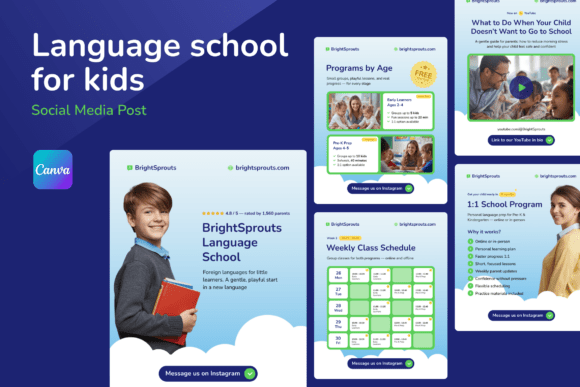
These templates typically include dedicated sections for critical data points that parents prioritize. For instance, layouts often feature clear blocks for age ranges (e.g., 2–4 years vs. 4–5 years), which helps parents instantly determine if a program fits their child's developmental stage. Other layouts are designed to highlight "1-on-1 School Preparation," a service that requires conveying a sense of personalized attention and academic rigor. By pre-structuring these elements, the templates reduce cognitive load for the viewer, allowing them to grasp the value proposition within seconds.
Furthermore, the visual style of these packs is intentionally bright and friendly, aligning with the psychological expectations of early education branding. However, unlike childish clip-art styles that can undermine credibility, modern iterations balance playfulness with clean typography and organized grids. This duality is essential; the design must appeal to children while reassuring adults that the institution is serious about educational outcomes.
Comparing Custom Templates Against DIY and Generic Solutions
When deciding how to manage social media graphics, administrators usually weigh three options: hiring a freelance designer, using a generic drag-and-drop tool, or utilizing a specialized template pack like the one described. Each approach carries distinct tradeoffs regarding cost, time, and brand consistency.
Hiring a Freelancer
- Pros: Offers unlimited customization and unique creative direction. A designer can create a bespoke identity from scratch.
- Cons: High cost per asset and slower turnaround times. If a school needs to post weekly schedules or daily updates, the recurring expense and delay can be prohibitive.
- Best For: Launching a new brand identity or creating high-stakes campaign assets.
Generic Design Tools
- Pros: Low barrier to entry and vast libraries of free assets. Users have total freedom to mix and match elements.
- Cons: Often leads to inconsistent branding. Without a cohesive system, a feed can appear disjointed. Additionally, finding templates that accommodate specific educational data structures (like class ratings or curriculum badges) requires significant manual adjustment.
- Best For: Schools with existing design skills and flexible budgets for time.
Specialized Template Packs
- Pros: Provides a consistent visual system out of the box. The layouts are pre-optimized for educational content, meaning less time is spent formatting text and more time is spent refining the message. Using free fonts ensures accessibility and removes licensing costs.
- Cons: Limited to the provided layouts. While customizable, the underlying structure remains fixed, which may restrict highly experimental design choices.
- Best For: Tutors and small-to-medium schools needing professional consistency on a tight budget.
For many educators, the Kids Language School Instagram Post templates represent a middle ground. They offer the structural reliability of a hired designer at a fraction of the cost, while remaining far more efficient than starting from a blank canvas in a generic tool.
Key Features That Drive Engagement and Trust
The effectiveness of any social media asset lies in its ability to convert viewers into leads. In the context of language learning, conversion often means a parent sending a direct message to inquire about enrollment or visiting a website to book a trial class. Specific features within these template packs are designed to facilitate this journey.
Structured Information Blocks
Parents need quick answers. Layouts that separate "Programs by Age" or "Weekly Class Schedules" allow users to find relevant information without scrolling through dense paragraphs. For example, a layout featuring group detail badges for ages 2–4 and 4–5 allows a parent to immediately see if their toddler qualifies for a specific session. This clarity reduces friction in the decision-making process.
Social Proof Integration
Trust is the currency of early education. Templates that include dedicated spaces for parent reviews or star ratings leverage social proof effectively. When a potential client sees a structured review block alongside a professional photo placeholder, it validates the quality of the instruction. This is particularly important for online or hybrid programs where parents cannot physically tour the facility before enrolling.
Call-to-Action (CTA) Optimization
A common pitfall in social media marketing is failing to tell the audience what to do next. These templates often include strategic placement for CTAs, such as "Message Us for Schedule" or "Link in Bio for More." By making the CTA a central part of the design rather than an afterthought, schools can guide traffic more effectively toward their enrollment funnels.
Visual Consistency Across Formats
A professional feed relies on uniformity. Whether posting a YouTube video announcement, a 1-on-1 tutoring promo, or a general school intro, the use of a cohesive template pack ensures that all posts feel like they belong to the same brand. This repetition builds recognition. Over time, parents begin to associate the specific color palette and layout style with the school's reputation for reliability.
Practical Implementation and Customization
One of the most significant barriers to using design resources is the technical skill required to modify them. Many premium templates rely on paid fonts or complex layer structures that frustrate non-designers. The Kids Language School Instagram Post pack addresses this by utilizing only free fonts. This eliminates the need for expensive software subscriptions or font licensing fees, ensuring that the final files render correctly regardless of the user's computer setup.
Customization is streamlined through intuitive image placeholders. Educators can replace demonstration photos with actual images of their classrooms, teachers, or students in minutes. It is important to note that preview images are for demonstration purposes only; the final files provide empty slots ready for your own content. This flexibility allows schools to maintain authenticity while adhering to a professional design standard.
For schools running hybrid models—combining in-person classes with online lessons—the versatility of these layouts is crucial. One template might highlight the interactive nature of a physical classroom, while another emphasizes the convenience and technology of an online module. Having a suite of six professionally designed layouts ensures that every type of offering receives appropriate visual treatment without breaking the overall brand narrative.
Decision Factors: Is This the Right Fit?
While these templates offer significant advantages, they are not a universal solution. Prospective users should evaluate their specific operational needs before committing.
Choose this option if:
- You run a language school, tutoring business, or early learning center and need to post consistently (e.g., weekly).
- You lack in-house design staff but want to maintain a high standard of visual quality.
- Your primary goal is to communicate structured information like schedules, age groups, and pricing clearly.
- You want to establish a cohesive brand identity across your Instagram feed quickly.
Consider alternatives if:
- You require highly unique, avant-garde designs that deviate significantly from standard grid layouts.
- Your marketing strategy relies heavily on video-first content where static posts play a minor role.
- You have a large budget and prefer the ongoing creative partnership of a full-time graphic designer.
Ultimately, the decision comes down to balancing efficiency with creativity. For most educators, the priority is delivering clear, trustworthy information to parents. A well-structured template pack removes the distraction of design struggles, allowing you to focus on what matters most: the quality of your teaching and the success of your students. By adopting a system that prioritizes clarity and consistency, language schools can build a digital presence that not only looks professional but also functions as an effective tool for growth.