Unlocking Young Minds: The Power of Science Experiment Vectors in Modern Education
In the evolving landscape of early childhood development, the intersection of visual art and scientific inquiry has created a unique tool for learning: the education kids science experiment vector. While the term might sound technical to the uninitiated, it represents a vital resource for teachers, parents, and curriculum designers. These digital illustrations, often characterized by clean black line pencil drawing styles, serve as more than just decorations; they are foundational elements that help children visualize complex concepts, from the bubbling reactions of child chemistry to the organized chaos of a school laboratory.
As we delve into the world of educational resources, it becomes clear that how we present information is just as important as the information itself. This article explores the significance of these vector illustrations, their role in fostering curiosity, and how they bridge the gap between abstract theory and tangible understanding for study children.
The Visual Language of Learning: What Are Science Experiment Vectors?
To understand the impact of these resources, one must first define what an education kids science experiment vector actually is. In graphic design, a "vector" refers to an image created using mathematical equations rather than pixels. This allows the image to be scaled infinitely without losing quality. When applied to education, these vectors become high-resolution, crisp illustrations that depict scientific scenarios.
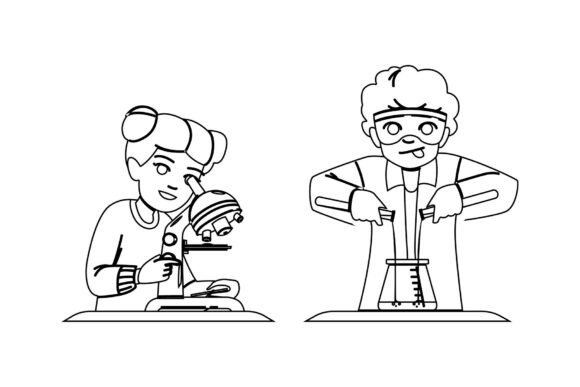
Often, these images take the form of a people black line pencil drawing illustration. Imagine a detailed sketch of a young student wearing safety goggles, holding a test tube, with another character observing closely. This style is not chosen merely for aesthetics; it is a deliberate pedagogical choice. The absence of distracting colors forces the viewer's eye to focus on the shapes, actions, and relationships between objects. For a child trying to understand a procedure, a simple black line drawing can be far more effective than a cluttered photograph.
Why Black Line Drawings Work for Children
Research in cognitive development suggests that simplified visuals reduce cognitive load. When a child looks at a colorful, realistic photo of a lab, they may get distracted by the texture of the table or the specific brand of the equipment. However, a pencil drawing illustration strips away these non-essential details. It highlights the core components: the beaker, the liquid, the flame, and the scientist.
This clarity is essential when introducing child chemistry. Concepts like mixing acids and bases or observing states of matter can be abstract. A vector illustration can exaggerate key features—such as showing steam rising dramatically from a flask—to make the invisible visible. Furthermore, these drawings often feature an education kids science experiment character, a relatable figure that guides the learner through the process, making the subject matter feel less intimidating and more like an adventure.
Bridging Theory and Practice in the School Laboratory
The primary purpose of these vectors is to simulate the environment of a school laboratory before a child ever steps foot inside one. Safety and preparation are paramount in real-world science, and these illustrations provide a safe sandbox for mental rehearsal.
Consider a lesson plan involving the water cycle or basic chemical reactions. Before handling real glassware, students can engage with worksheets or interactive screens featuring these vector graphics. They might be asked to color the diagram, label the parts, or sequence the steps shown in a series of drawings. This active engagement reinforces memory retention and builds confidence.
Practical Applications in the Classroom
Teachers utilize these resources in various ways to enhance the learning experience:
- Instructional Diagrams:
- Assessment Tools: Quizzes where students identify missing equipment in a black line drawing of a lab setup.
- Creative Writing Prompts: Using an image of a study children education kids science experiment character conducting a mysterious reaction to inspire stories about discovery and problem-solving.
- Coloring Activities: Allowing students to personalize the science equipment, which helps them memorize the names and functions of tools like Bunsen burners, microscopes, and graduated cylinders.
By integrating these visuals, educators create a multi-sensory learning environment. The tactile act of coloring or tracing a vector image, combined with the verbal explanation of the science behind it, creates a robust neural pathway for knowledge acquisition.
Fostering Curiosity and Creativity Through Design
Beyond rote learning, the use of education kids science experiment vector imagery plays a crucial role in nurturing creativity. Science is often perceived as rigid and formulaic, but true innovation requires imagination. The artistic style of these vectors—often whimsical yet accurate—invites children to think outside the box.
When a child sees a character in a pencil drawing successfully completing an experiment, it serves as a powerful role model. It normalizes the idea that anyone can be a scientist. This is particularly important for underrepresented groups in STEM fields. Seeing diverse characters in these illustrations helps children envision themselves in those roles, breaking down barriers and stereotypes early in their educational journey.
The Role of Technology in Modern Education
In today's digital age, these static vectors are becoming dynamic. Interactive whiteboards and tablets allow students to manipulate these images. They can drag and drop virtual chemicals into a drawn beaker or animate the movement of particles. This evolution from paper to screen does not diminish the value of the original black line aesthetic; instead, it enhances it. The clean lines render perfectly on high-definition displays, ensuring that the educational content remains sharp and legible regardless of the device used.
Furthermore, the versatility of vector graphics means they can be easily adapted for different age groups. A simple version of a science experiment character might be used for preschoolers to learn about mixing colors, while a more complex version with detailed lab equipment can be used for middle schoolers studying stoichiometry. This scalability makes them an invaluable asset for long-term curriculum planning.
Common Misunderstandings About Educational Illustrations
Despite their widespread utility, there are some misconceptions regarding the use of vector illustrations in science education. One common assumption is that these drawings are merely "filler" content, lacking the rigor of photographs or real-life demonstrations. This is a fundamental misunderstanding of their purpose.
Photographs capture reality, but they do not always explain it. A photo of a chemical reaction shows the result, but it rarely explains the mechanism. A well-designed vector illustration can include arrows, labels, and cross-sections that reveal the internal processes of an experiment. It translates the "what" into the "how" and "why."
Another misconception is that these resources replace hands-on learning. On the contrary, they prepare students for it. Just as a pilot uses a simulator before flying a plane, a student uses these visual aids to understand the protocol before entering the actual school laboratory. They reduce anxiety and increase safety awareness, ensuring that when the time comes for real experimentation, the students are ready.
Building a Broader Understanding of Science
Ultimately, the goal of incorporating education kids science experiment vector resources is to build a broader, more inclusive understanding of science. By combining the precision of scientific method with the accessibility of art, we create a learning environment that welcomes every child.
Whether it is a people black line pencil drawing illustration depicting a group of friends collaborating on a project or a solo education kids science experiment character making a breakthrough discovery, these images tell a story. They communicate that science is a human endeavor, filled with trial, error, and triumph. They transform the sterile concept of study children education into a vibrant narrative of exploration.
As we look toward the future of education, the integration of such thoughtful design elements will only grow in importance. In a world increasingly driven by technology and data, the ability to visualize, interpret, and create meaning from complex systems is a critical skill. These humble vector drawings are doing more than just decorating textbooks; they are laying the groundwork for the next generation of innovators, engineers, and scientists.
For parents and educators seeking to enrich their teaching materials, exploring high-quality vector libraries can yield significant dividends. Look for resources that prioritize clarity, accuracy, and engagement. By choosing illustrations that respect the intelligence and curiosity of children, we empower them to ask better questions and seek deeper answers. After all, every great discovery begins with a spark of imagination, often ignited by a simple, well-drawn picture.